Sunday, 5 December 2010
'A Void' by Georges Perec

Sunday, 21 November 2010
The Pneumatic Transit System of Alfred Ely Beach

Sunday, 14 November 2010
The Cook's Tale

Sunday, 7 November 2010
On the Silver Globe

Sunday, 31 October 2010
Big Numbers

Sunday, 24 October 2010
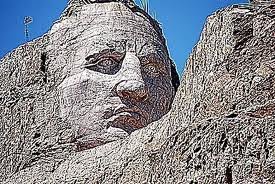
Crazy Horse Memorial

Sunday, 17 October 2010
Nelson Pillar

Sunday, 26 September 2010
Napster Bombs

Sunday, 19 September 2010
Arrive Alive

Sunday, 12 September 2010
Vulcan

Sunday, 5 September 2010
Coventry Cathedral

Sunday, 29 August 2010
Carnival of Light

The Million Volt Sound and Light Rave was an arts festival that ran at the Roundhouse Theatre in Chalk Farm in January 1967.
It was organised by the designers Binder, Edwards and Vaughan and is most famous for a musical piece that David Vaughan had requested from Paul McCartney.
Vaughan had recently painted a psychedelic design onto a piano for McCartney and invited the Beatle to contribute a musical piece for the festival.
At this point the Beatles were the most popular band in the world so Vaughan was shocked when McCartney agreed to do so.
Given a free hand to produce anything they wanted Lennon and McCartney recorded a backing track of an organ playing bass notes with some drums speeded up and improvised what was recorded over it.
McCartney described the recording process as him telling people:
‘All I want you to do is just wander around all the stuff, bang it, shout, play it, it doesn’t need to make any sense. Hit a drum and then wander onto the piano, hit a few notes and just wander around.’
Lennon and McCartney then added Native American war cries, whistling, closed-mike gasping, genuine coughing and fragments of studio conversation.
A church organ, a cinema organ and a pub piano were also incorporated into the mix along with Lennon and McCartney screaming dementedly and bellowing out random words and phrases such as ‘Barcelona!’, ‘Electricity!’ and ‘Are you alright?’
Dudley Edwards, of Binder, Edwards and Vaughan, claimed that an early take of ‘Fixing a Hole’, which would appear later that year on ‘Sgt. Pepper’s Lonely Hearts Club Band’ also appeared on this track.
The track was called ‘Carnival of Light’ and has never appeared on any official Beatles release. McCartney claimed that he wanted to include it on the ‘Beatles Anthology 2' album in 1996 but was blocked by George Harrison. According to McCartney, Harrison rejected it as ‘he wasn’t a fan of avant garde music.’
Given the experimental nature of Harrison’s work, in and out of the Beatles, it seems more likely he wasn’t a fan of random noises that isn’t really music at all...
Sunday, 22 August 2010
The Geisel Library

The Geisel Library is the main library building on the University of California, San Diego campus. It is named after Audrey and Theodor Seuss Geisel, better known as Dr. Seuss, for their contributions to the library and their work in promoting literacy.
In the building itself the lower floors are numbered 1 and 2 and the upper floors are numbered 4 to 8. A popular explanation for the library having that empty or inaccessible space where the third floor should be is that the architect, while designing the building to take it’s own weight and the movement of people within it, failed to account for the weight of the books that would fill the library.
The theory then contends that once the library was filled with books it began to sink and part of the space was reclaimed to stop the buildings foundations from collapsing.
In reality the story of the ‘sinking library’ is a popular urban myth and has been told about many buildings around the world.
The space where the third floor would be in the Geisel Library is outside and so is not indicated on the buildings interior. The only use the ‘third floor’ has inside the building is providing an emergency exit for the upper floors.
Dr. Seuss would be disappointed by such a mundane explanation...
Sunday, 15 August 2010
The Wicked Bible
Robert Barker was the printer of the first edition of the King James Bible, one of the most significant books published in the English language.
The King James Bible was first produced in 1611 but featured uneven printing lines and a poor quality typeface.
Barker made little money from the book but gained some fame as it was to become the official edition of the bible for the Church of England.
By 1631 Barker was the Royal Printer, along with Martin Lucas, and decided to publish a new edition of the King James Bible.
This version had a better typeface and was a vastly superior visual production compared to the shoddy first edition but it was far from perfect.
A compositors mistake in the Ten Commandments (Exodus 20:14) managed to omit the word ‘not’. This transformed the Commandment from
Barker and Lucas were called to the Star Chamber, where they were found guilty of publishing the blasphemous bible. They were fined £300 and copies of what became known as the ‘Wicked Bible’ were recalled and burned.
Eleven copies survived, most of which are now held by prominent libraries around the world.
A privately owned copy was put on sale early in 2010 with a price tag of $89,500.
Other mis-typed bibles have been produced by careless publishers over the years.
Cambridge Press released an edition in 1653 that became known as the ‘Unrighteous Bible’.
Here they omitted the word ‘not’ from 1 Corinthians 6:9 which turns
In 1763 a bible was published with Psalm 14:1 reading
The printers were fined £3,000 and all copies were ordered to be destroyed...
Sunday, 8 August 2010
Alan Roy's Stamp Collection

Many stamp collectors like to have a certain focus to their collections.
They will centre their collections around the output of a particular country, a certain timespan or special events such as the Olympics or Christmas.
Alan Roy just collected stamps. Any stamps. He tried to get his hands on as many stamps as he could without any regard as to their individual value.
His family were pressed into service removing the stamps from the envelopes that were delivered to their house by the sackload on a daily basis.
His daughter, Janette Dorrell, recalled a childhood dominated by her father’s hobby:
‘I grew up surrounded by stamps.
He used to get sacks and sacks of used envelopes delivered to the flat from various contacts around the world and we used my old baby bath to peel them off. Dad started when he was very young and it just grew and grew. It was relentless.
As soon as I got married and moved out he filled my old room up with his stamps. When I left my mother took over as the main helper but he often roped in my twin daughters to help.
You could say that I never want to see another stamp ever again.’
On average Alan Roy processed 80 stamps per day or nearly 30,000 per year.
Over a period of 70 years he managed to accumulate over 2 million stamps.
His plan was to organise the collection and sell it to fund his retirement but the huge scale of the operation and the fact that the collection had no finite aim or coherent theme made any attempts at cataloguing the stamps impossible.
Instead the stamps were stored in random bundles and when Alan Roy died in 2009 the collection was sold in vaguely themed packs based around events and countries of origin.
It was believed that, due to the scope of the collection, if it had been properly catalogued and released onto the market in an organised fashion it could have been comprehensive enough to effectively flood the market and depress the values of stamps around the world.
Alan Roy was a postman...
Sunday, 1 August 2010
The Don Quixote of Orson Welles

In 1955 Orson Welles was commissioned by CBS television to produce a 30 minute film adaptation of the Miguel de Cervantes novel ‘Don Quixote’.
Given the epic scale of the book and the limitations of time and budget that had been placed upon him, Welles decided to produce a film set in the modern age with Don Quixote and Sancho Panza as anachronisms, bewildered by the advances of the future.
Welles produced some test footage with Mischa Auer as Don Quixote but CBS were unhappy with both the shots they saw and the concept of the project and cancelled production.
By this point Welles had decided to expand the film to feature length and produce it independently. Frank Sinatra invested $25,000 in this new version and Welles provided additional funding from his own earnings as an actor and director.
Spanish actor Francisco Reiguera was cast as Don Quixote, Akim Tamiroff, a Russian born actor, was cast as Sancho Panza and American child actress Patty McCormack was brought in to play a little girl that would meet Don Quixote and Sancho Panza and explain the modern world to them.
The production was undertaken without a script with silent scenes being improvised around the streets of Mexico City where the initial filming took place.
Welles planned to dub in the dialogue at a later date as he enjoyed working with the improvisational style that he felt was similar to the production of early silent comedies.
Eventually funding began to dry up and filming became a haphazard affair that Welles would organise around other, more lucrative, work.
Production was moved to Spain to save money but this proved problematic as Reiguera was a Republican exile from the Spanish Civil War and could not always be guaranteed access to the country.
Work on the film stretched from the Fifties into the Sixties with no end in sight.
As the filming slowed down McCormack physically outgrew her role and had to be dropped from the film. Welles amended the concept by introducing himself as a character, playing a film director who wanted to cast Don Quixote and Sancho Panza as themselves in a adaptation of the book he was filming.
By 1972, Francisco Reiguera and Akim Tamiroff were both dead and the film was still not finished.
Welles claimed that he had completed as the principal photography he needed with both actors and the film simply needed to have the dialogue dubbed onto it, which he planned to do himself, and be edited together.
Months before his death in 1985, Welles was still insistent that he would be able to complete the film.
Orson Welles died on the 10th of October 1985 with his Don Quixote still unfinished.
Footage was stored all over the world, some of it not stored properly and ruined, and other footage apparently lost.
In 1990 Spanish producer Patxi Irogoyen and director Jesus Franco acquired the rights to the footage from the project.
Once they assembled all the film they could get they realised that over the life of the production Welles had worked in various formats of film which meant that visually the film would look inconsistent.
The lack of a script and the changes in the concept over time also meant that in terms of narrative the film was confused at best and Welles had only recorded part of the dialogue to be dubbed over the footage.
Irogoyen and Franco did what they could. A new script was produced and actors hired to complete the dialogue.
In 1992 ‘The Don Quixote of Orson Welles’ premiered at the Universal Exposition in Seville.
The premiere was threatened when an Italian film editor called Mauro Bonnani called on organisers to not show the film as he had 20,000 meters of footage in his possession that he felt was integral to a reasonable version of the film being completed. Bonnani was unable to come to an agreement with Iroygen and Franco over the use of his footage and a lawsuit soon followed.
Reviews of the film were mostly negative and, although it was screened at Cannes that year, it has never had a commercial cinematic release...
Sunday, 25 July 2010
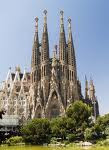
Sagrada Familia
When completed, the Sagrada Familia in Barcelona will be the tallest church building in the world and will have the tallest spire of any church in the world.
It will, however, also be a metre shorter than Montjuic, a nearby hill, as the architect, Antoni Gaudi, was determined that his work should not surpass that of God.
Gaudi was not the first designer commissioned to work on the Sagrada Familia but few projects and architects are more closely associated than Gaudi and his ambitious masterpiece.
Initially, Francesc del Villar was appointed to oversee the construction of the church in 1882 but he resigned after a year due to disagreements with the backers and the commission was passed on to Gaudi in 1883.
del Villar’s was due to be a rather simple neo-Gothic design and Gaudi originally intended to see the project through using an outline very similar to del Villar’s.
By 1889 the crypt was completed and construction on the main body of the building was due to begin. However, just as the next stage of the project was to start the church received a huge donation that prompted Gaudi to have another look at the design of the church.
He discarded the neo-Gothic outline in favour of a monumental structure that would incorporate Modernist elements and be loaded with symbolism.
Gaudi intended his new church to be nothing less than a catechistic explanation of the teaching of the Gospels and the Catholic Church.
He realised that the ambition of the new project put it’s completion beyond his own lifetime and worked on other buildings and commissions alongside the Sagrada Familia. However, in 1914 Gaudi decided to concentrate all his energies on his church and he completed no other major works after this point.
By 1926 Gaudi was living in a room next to his workshop and was devoting all of his time to the Sagrada Familia. He cared little for his appearance and carried little money except for what he needed to buy food.
On July 7th of that year Gaudi was hit by tram in Barcelona. Due to his dishevelled appearance and the lack of money about him he was dismissed as a vagrant and cab drivers refused to take him to hospital. Eventually he made it to a pauper’s hospital where he was unrecognised until his concerned friends manage to track him down the next day.
They arranged for him to be transferred to a better hospital but Gaudi refused saying ‘I belong here among the poor.’
Antoni Gaudi died on the 10th of July 1926 and is buried in the crypt of the Sagrada Familia.
Work continued on the church using the detailed plans that Gaudi had left behind.
In 1938, during the Spanish Civil War, anarchists destroyed Gaudi’s workshop which contained all his plans and models for the Sagrada Familia.
The church is now being completed based on reconstructed versions of Gaudi’s plans and modern adaptations.
The Sagrada Familia is due to be consecrated by Pope Benedict XVI on November 7th 2010.
Construction is due to be completed by 2026.
When challenged by critics who complained about the proposed length of the construction of the church Gaudi replied simply:
‘My client is not in a hurry...’
Sunday, 18 July 2010
Woyzeck
Georg Buchner was a German writer who died in 1837 leaving his most famous work, ‘Woyzeck’, incomplete and in a largely fragmentary state.
It is the story of a soldier who is dehumanised by society and kills a widow he has been living with.
He then takes the knife that he committed the murder with to a lake to clean the blood off.
Buchner’s tale ends here but most completed versions have Woyzeck drowning in the lake while attempting to clean the knife.
Despite, or perhaps because of, it’s unfinished nature ‘Woyzeck’ has proved very popular as a piece for adaptation.
Versions have included a production by the Splendid Theatre where the scenes are performed in the order they were found among Buchner’s papers rather than chronologically, a puppet theatre version ‘Woyzeck on the Highveldt’ from the Handspring Puppet Company and a modern version ‘Re: Woyzeck’ by Jeremy Gable which features Georg Buchner as a character in his own play.
‘Woyzeck’ has also proved inspirational to musicians as well.
Nick Cave has provided music for a production in Australia in 2009 and Tom Waits wrote a musical version of the story with Robert Wilson with the songs appearing on the ‘Blood Money’ album that Waits released in 2002.
Arguably the best known adaptation is the Werner Herzog feature film released in 1979 and starring Klaus Kinski in the title role.
Herzog began production just five days after completing work on ‘Nosferatu the Vampyre’ and retained the same crew and lead actor in Kinski, all exhausted by the previous project.
Filming only took 18 days and the film was edited together in another 4 days.
Herzog’s ‘Woyzeck’ was nominated for the Palme d’Or in Cannes in 1979 and Eva Mattes won the award for Best Supporting Actress for her portrayal of Marie, Woyzeck’s lover and eventual victim.
Sunday, 11 July 2010
"The Spaghetti Incident?"

"The Spaghetti Incident?" is an album of cover versions released by Guns ‘N Roses in 1993.
The album had 12 tracks listed, covering songs by the likes of The Stooges, The New York Dolls, The Damned and T. Rex, but actually featured 13 tracks.
At the end of track 12, a cover of the Fear song ‘ I Don’t Care About You’, there is a period of silence and then a hidden song begins.
The song is ‘Look At Your Game, Girl’ and was originally written and performed by Charles Manson. It first appeared on the 1970 album ‘Lie: The Love and Terror Cult.’
At this point Manson was on trial for his involvement in a series of murders undertaken at his direction by his ‘Family’ of followers. The proceeds of the album were to go towards funding his legal fees.
Eventually Manson would be found guilty of Murder and Conspiracy and sentenced to death.
The death sentence was later commuted to life imprisonment.
Fearful of media outrage at the songs inclusion, the members of Guns ‘N Roses pleaded with Axl Rose, the band’s lead singer, not to put it on the album but Rose was insistent.
Tellingly, no other members of Guns ‘N Roses appear on the track. It features Rose on vocals accompanied by Carlos Booey on guitar.
Following his conviction all the proceeds from Manson’s recordings go to the families of his victims and funds for victims of violent crime. Under California state law convicted criminals are prohibited from collecting money or royalties for their work.
Other artists have covered songs from ‘Lie: The Love and Terror Cult’ including GG Allin, The Brian Jonestown Massacre and, almost inevitably, Marilyn Manson.
The most popular song to cover is ‘Cease To Exist’ which has been recorded by Redd Kross, The Lemonheads and the Beach Boys.
Manson had lived and recorded with Dennis Wilson of the Beach Boys for a while in 1968 and a version of ‘Cease To Exist’ re-titled ‘Never Learn Not To Love’ appeared on the B-side of the 1968 Beach Boys single ‘Bluebirds Over The Mountain.’ This version was credited to Wilson and Manson. The Beach Boys version is significant for a major change in the lyrics where Manson’s line ‘Cease to exist’ becomes ‘Cease to resist’ and refers to the acceptance of love, radically altering the meaning of the song.
By the time ‘Never Learn Not To Love’ appeared on the Beach Boys 1969 album ‘20/20' Manson had been ordered to move out of Wilson’s home by Wilson’s manager and had relocated his ‘Family’ to a ranch in the desert and had began to plan his murderous scheme.
On the album the song is credited entirely to Dennis Wilson...
Sunday, 4 July 2010
Stari Most

Suleiman I, His Imperial Majesty Grand Sultan, Commander of the Faithful and Successor of the Prophet of the Lord of the Universe was the tenth Sultan of the Ottoman Empire.
He reigned from 1520 to 1566 and is better known simply as Suleiman the Magnificent.
In 1556 he commissioned a local architect, Hajrudin, to build a bridge in the town of Mostar in Bosnia to span the river Neretva.
Hajruddin accepted the commission and proposed to create a dazzling structure using locally quarried stone and an unorthodox mortar of horsehair and eggwhite.
Suleiman accepted this but warned Hajrudin that if the bridge collapsed he would be executed.
Hajrudin pressed on with his project but reportedly made arrangements for his funeral as the bridge approached completion.
Once the bridge was completed Hajruddin lost all faith in his creation.
The night before the scaffolding was to be removed and the Sultan was due to arrive to inspect the bridge Hajrudin fled and was never heard of again.
The bridge stood for almost five hundred years.
Despite the concerns of the Sultan, and the fears of Hajrudin, the Stari Most never collapsed under its own weight or subsided over time.
Instead mortar fire in 1993 during the Bosnian War did what time and use could never accomplish and brought the Stari Most down.
After the war plans were made to reconstruct the bridge.
The Stari Most was rebuilt to the same specifications and dimensions that Hajrudin designed.
A combination of locally quarried stone and material recovered from the river below was used in its construction.
The engineers refused to reveal what was used for mortar...